


Bey-Berk
Bey-Berk 2 Watch Winder & 4 Watch Storage in Lacquered Ebony Burl Wood
Bey-Berk 2 Watch Winder & 4 Watch Storage in Lacquered Ebony Burl Wood
Couldn't load pickup availability
Share


The Opening Note
An automatic watch is the only thing you own that keeps its own time by being worn. Take one off on a Friday evening and by Sunday afternoon it has gone quiet — not broken, simply run down, waiting. Wind it, set it, and it picks up as though nothing had happened.
For one watch that is no trouble at all. It becomes trouble at three. With one watch, the perpetual calendar has stopped and wants the day, the date, the month and often the moon put back by hand. And then there's the watch you inherited — the one you wear twice a year — and which spends the other three hundred and sixty-three days lying perfectly still.
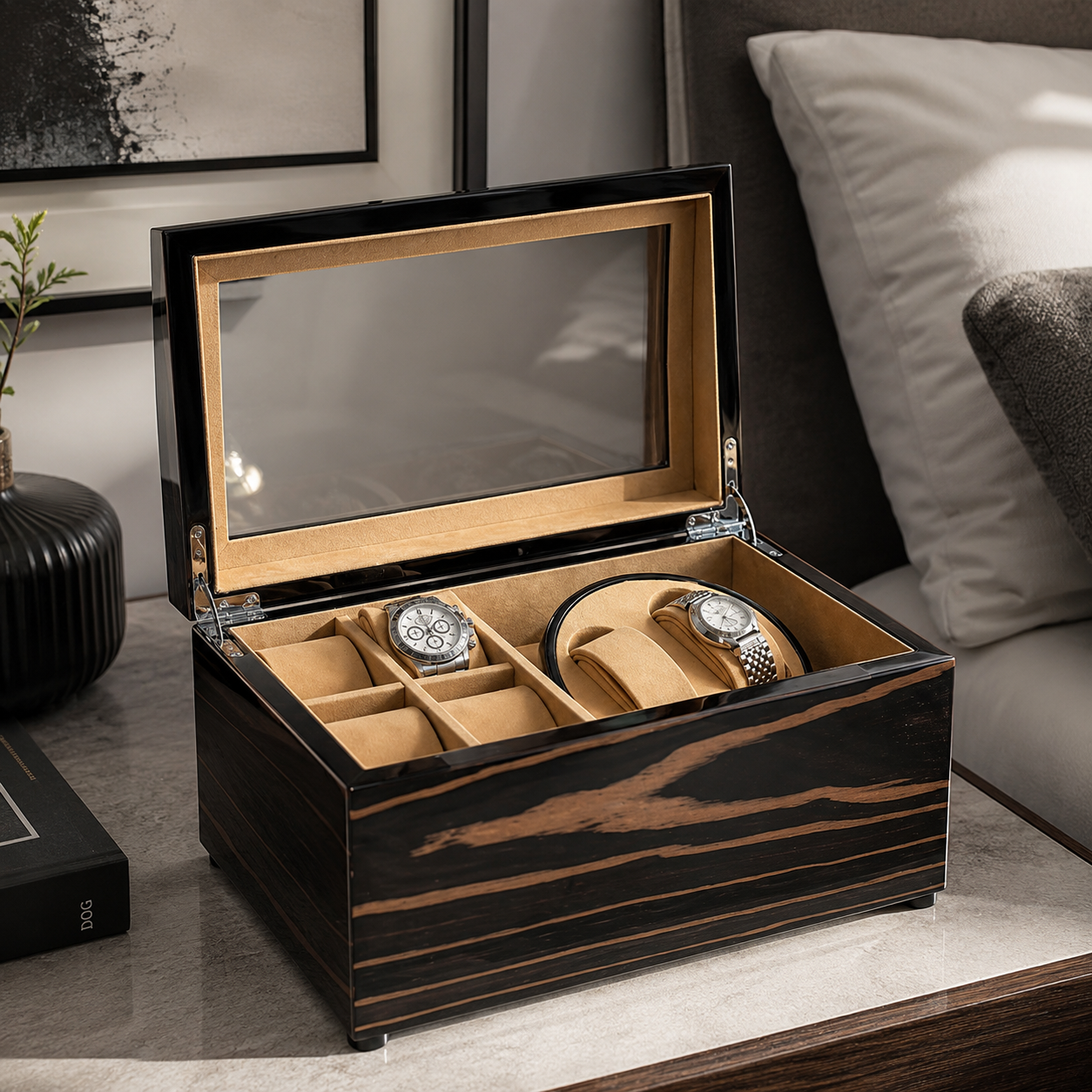
This case holds six and keeps two of them running. Ebony burl under high-gloss lacquer, a glass lid, velour underneath. The whole of it is built to be looked at, which is the real argument for a dresser rather than a closet shelf: a collection you can see is a collection you wear.
What it holds
Room for the two you actually rotate turning quietly under glass, three more waiting on their cushions beside them, and the one on the worn leather strap that no longer fits your wrist but that you will never sell.
A note on the number
Bey-Berk's headline figure for this winder is that it "rotates over 4,300 times a day."
A modern automatic movement needs somewhere around 650 full rotations in twenty-four hours to stay wound, and that single figure covers the large majority of what people own. Some chronograph movements ask for nearer 800. A few micro-rotor calibers want a little more. Nothing in ordinary circulation asks for four thousand.
So 4,300 is roughly six times what a typical watch is asking for. What it actually tells you is that this is a continuously running winder rather than one that works in short cycles and rests between them.
Specifications
Capacity
2 winding positions
4 static storage wells
Cushion size and wrist fit: Not stated by the manufacturer.
Storage well dimensions: Not stated by the manufacturer.
Movement
Turns per day: rated at over 4,300 rotations a day.
TPD range: Not stated by the manufacturer. Bey-Berk publishes a single total and no adjustable setting. This is the figure discussed above.
Direction: selectable — single or dual direction.
Direction settings: Not stated by the manufacturer. Whether "single" means clockwise, counter-clockwise, or a choice between the two is not published.
Programs and intervals: Not stated by the manufacturer. No rest cycle is described.
Motor noise: Not stated by the manufacturer.
Case
Exterior: 6.5"H × 11.75"W × 8"D
5.95 lbs
Ebony burl wood veneer, high-gloss lacquer
Glass top — glass type not stated by the manufacturer
Interior: velour lined throughout
Lock: none
Power
AC mains.
Power options: Not stated by the manufacturer. Bey-Berk lists AC power alone. Adapter included.
The rest
Warranty: Not stated by the manufacturer.
Manufacturer part number: BB621EBN
Finish: lacquered ebony burl
Two notes on the figures above. Bey-Berk publishes the case size unlabelled, as 11.75 × 8 × 6.5. We have read that as width, depth and height — the only order in which the object makes sense — and quoted it in our own house order. And where you see 8 lbs given for this piece elsewhere, that is the shipping weight with its packaging; the case itself is 5.95 lbs.
What the wood is, and why it costs what it costs
Burl is the tree's scar tissue, and it is the most figured timber a tree will ever produce. No two panels of it are alike, which is why the piece that arrives will not be identical to the photograph, and why that is the point rather than a flaw.
That same structure is why you will never find a solid burl anything. The grain has no run to it, so it splits and moves; burl is sliced thin as veneer and laid over a stable core. What the lacquer buys you is depth — coat, cure, sand, repeat, until the figure appears to sit some way beneath the surface rather than on it. That is a furniture finish rather than a box finish, and it is most of the difference between this and a winder costing a fifth as much.
Two consequences, both practical. High-gloss lacquer shows dust and fingerprints the way a piano lid does: a dry microfiber cloth, and nothing with solvent in it. And keep it out of direct sun. Ultraviolet light is unkind to lacquer and unkinder to veneer, and a case that lives in a south-facing window will look tired years before one that sits three feet further into the room.
What your watch is actually asking for
Every automatic movement has a figure and a direction. The figure is the turns per day it needs. The direction is the way its rotor winds — clockwise, counter-clockwise, or either. Most modern movements are bidirectional and want around 650 TPD. The Valjoux 7750, the chronograph movement inside a great many watches that do not advertise it, is conventionally set clockwise-only at around 800. Some micro-rotor calibers prefer counter-clockwise. Your watch's maker publishes both figures, and they take a minute to find.
This winder gives you the direction and not the rate. That is the honest summary of it: single or dual direction is yours to set, and the turns per day are what they are.
What follows from that is less alarming than it sounds. A mainspring cannot be overwound in the sense people mean by the word. When it is full, a slipping bridle lets the barrel turn on without loading it further, and the watch is in no danger at all. What excessive winding does instead is keep that bridle slipping, hour after hour, on a watch that was already full by breakfast. Nobody can honestly tell you it costs a year of service life. It is simply more work than the movement was ever asked to do.
The remedy costs about fifteen dollars, and we would rather you knew it than not. Put the winder on a plug-in outlet timer — the mechanical sort sold for lamps — and give it four to six hours a day. That works out between roughly 700 and 1,100 turns, which is comfortably above what a movement needs and a quarter of what the winder would otherwise deliver. A great many collectors do exactly this with continuously running winders at every price. And if what you want instead is a programmable winder with a settable TPD and a proper rest cycle, that is a different machine, and we will gladly point you at one.
On the maker
Bey-Berk was founded in 1981 and works out of Chatsworth, California — two families, Beylerian and Berksanlar, whose names are the company's. It is now run by the founders' sons. The catalogue is broad: watch and jewelry storage, desk pieces, travel cases, bar and cigar accessories, better than a thousand items, sold through department stores and specialty retailers rather than under someone else's label.
We carry their winders because they solve the problem most winders fail at, which is looking like something a person would choose to have out. The mechanism inside this case is not exotic, and to their credit Bey-Berk does not pretend that it is. The wood and the finish are the reason to buy it.
Questions
Single or dual direction — which do I choose?
Dual, unless your watch says otherwise. Bidirectional is the safe default for most modern movements, and it is what nearly everything you are likely to own prefers. The exception worth knowing is the Valjoux 7750 chronograph, which is conventionally wound clockwise-only. Bey-Berk does not publish which way "single" turns on this model, so if you own a 7750 and it matters to you, ask us before you buy and we will find out.
Can I put six watches on it and have them all wind?
No. Two wind, four rest. The four wells are storage — velour-lined, glass-topped and rather good, but static.
Does it run on batteries?
Bey-Berk states AC power. Two sellers describe a battery backup, which we cannot see claimed anywhere by the manufacturer, so we have not repeated it. Treat it as a mains appliance and plan an outlet for it.
Is it quiet enough for a bedroom?
We do not know, and we would rather say so than guess. Motor noise is not published for this model. What we can tell you is that continuously running winders hum continuously, where a cycling winder is silent most of the hour — which is one more argument for putting it on a timer set to run while you are out of the room.
Do I need a winder at all?
Honestly: if you own one automatic and wear it most days, no. Winders earn their place at three or four watches, and earn it decisively the moment one of them has a perpetual or annual calendar you would rather never reset again. Everything after that is pleasure, which is a perfectly good reason on its own.
How do I look after the finish?
A dry microfiber cloth, in the direction of the gloss. No sprays, no solvents, nothing with silicone in it. Keep it out of direct sunlight and off a heat source, and the lacquer will outlast the motor.


