Barska
Barska Fireproof Safe Vault - 3.90 cu ft Interior, Keypad, AX12674
Barska Fireproof Safe Vault - 3.90 cu ft Interior, Keypad, AX12674
Couldn't load pickup availability
Share


Paper is the first thing a fire takes and the last thing anyone thinks to move. The deeds, the will, the passports, the folder of certificates that proves a life happened in the order it did — most of it sits in a drawer or a box file on a shelf, unhidden and unprotected, because there has never been an obvious place to put it that was any better.
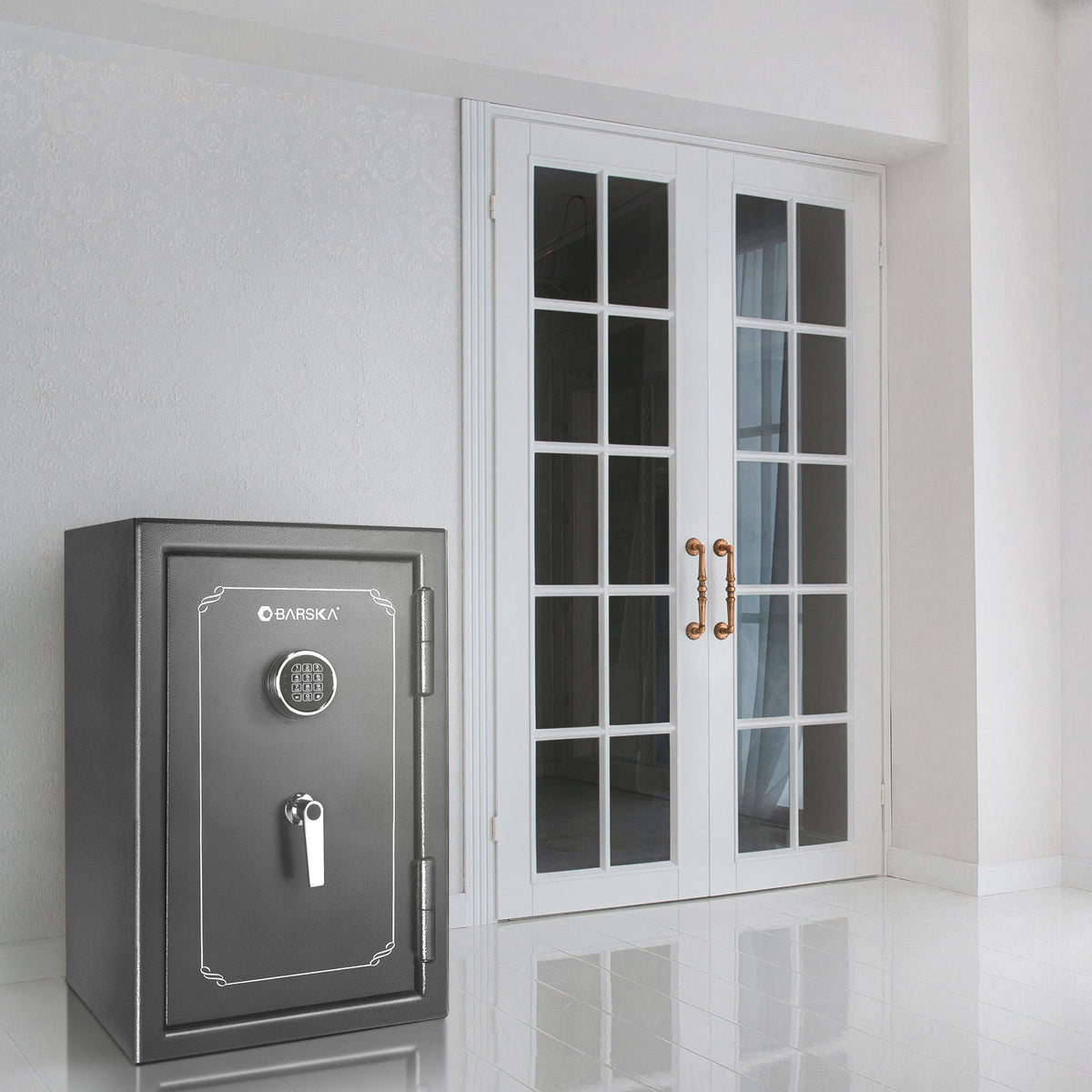
This is a tall, plain cabinet built for exactly that. It stands thirty inches high and twenty across, weighs a hundred and sixty-nine pounds, and is lined with gypsum board against half an hour at 1,400°F. The inside is carpeted, with two shelves you can move to whatever heights your own papers want. Nothing about it is decorative. It takes files standing upright rather than stacked flat, and it is insulated rather than merely strong, which is a different and more useful thing.
What it holds
Room for the deeds and the family papers standing upright, a photo album laid flat on the shelf below, and the watch that stopped years ago and was never sent away to be mended.
A note on the number
Barska market this safe as 4.39 cubic feet. Their own specification gives the interior as 27.5 by 17.5 by 14 inches, and that multiplies out to 3.90. We've put 3.90 because interior volume is calculated the same way on every page in this store — it is the only way two safes here can be compared on the same terms when their makers count differently.
Specifications
Interior
27.5"H × 17.5"W × 14"D
Interior volume, calculated: 3.90 cu ft
Two shelves, adjustable and removable
Fully carpeted interior
Inner locking box: none
Exterior & siting
30"H × 20"W × 20"D
169 lbs
Mounting hardware included
Gloss black finish
Security
Keypad entry, two PIN codes
Override: backup keys, reached by lifting off the keypad
Three solid steel deadbolts
Recessed, pry-resistant door
Body 1.18" · Door assembly 1.02" — steel and gypsum board together, as the manufacturer states it; the steel alone is not stated separately
Low-battery warning
Fire, water & media
Fire rating: 30 minutes at 1,400°F, as stated by the manufacturer. Certifying body: not stated by the manufacturer.
Media / data rating: Not a media safe.
Water rating: None claimed.
The rest
One 9V battery, not included
Warranty: 1 year limited
Manufacturer part number: AX12674 — FireVault FV500
UPC: 790272002122
What the weight buys you
A hundred and sixty-nine pounds is more than a steel box this size has any business weighing, and the steel is not where it went. The weight is in the lining. Barska give the body as 1.18 inches and the door as 1.02, steel and gypsum board counted together, and the gypsum is most of both.
Gypsum holds water inside its crystal structure. Bring heat to it and that water leaves as steam, taking the energy with it, and while there is moisture left to spend the inside of the cabinet stays nearer the boiling point of water than the temperature of the room it is standing in. That is the whole mechanism, and it is why fire protection is a matter of weight rather than hardness. Thirty minutes at 1,400°F is the measure of how long this particular wall thickness can spend it.
Where the fire starts, how soon it is found and what the floor above is doing all change the arithmetic, and none of them are in the number. Two practical things follow from that. Heat gathers at the ceiling, so a cabinet standing on a closet floor spends a fire in the coolest air the room has.
The inside, thought through
The useful thing here is the height. Twenty-seven and a half inches of clear interior, with both shelves out, is a bay tall enough to stand legal folders and box files upright the way they stand in a filing cabinet — which is how papers are actually kept. Most safes at this size are wider than they are tall and force everything onto its side in a pile.
The two shelves adjust and lift out entirely, so the cabinet can be a single tall bay, a deep bottom bay with a shallow shelf above for small things, or three even levels. Fourteen inches of depth takes a box file comfortably and a photo album flat. The carpet lining is not a luxury detail: it stops a watch case or a camera body sliding about when the door swings, and it keeps steel from marking what is set down on it.
The lock takes two PIN codes, which matters in a household where two people will both want in without sharing one. The keypad lifts off to expose a key lock underneath, and two backup keys come in the box for the night the battery is flat — a 9V, not included, with a low-battery warning that gives you notice before it gets to that.
Getting it into the house
This ships as a freight delivery, on a pallet, and the carrier's service ends at the curb. That is what LTL means by delivery — the pallet comes down on a liftgate at the end of your driveway, or at the nearest accessible point at a business address, and everything past that point is yours to arrange. Inside delivery, unboxing and removal of packaging are not part of it.
At 169 pounds it is a two-person job with a proper stair-climbing dolly rather than a rigging job. The cabinet is twenty inches across at its widest and thirty tall, so it clears a standard 36-inch front door and the 30 to 32 inches of an ordinary interior doorway. An upstairs placement is fine at this weight; set it near a bearing wall rather than mid-span if the room gives you the choice.
Allow 7 to 14 business days, and expect a call from the carrier to arrange a window. Two things to do on the day, both of which matter more than they sound: look the pallet over before you sign the delivery receipt, and write anything wrong onto the receipt itself before signing, with photographs. Damage raised after a clean signature is a much harder conversation.
If you need it taken further than the curb, tell us your address before you order and we will find out what can be arranged and what it comes to.
What this is not
It is not fireproof, whatever the trade calls it — this page included. The word is a category convention. What exists is a rating: thirty minutes, 1,400°F, measured in a furnace. Past the half hour no claim is made, and we make none either.
It is not a media safe. The rating protects paper. Drives, tapes, negatives and slides need an interior held below 125°F, which is a stricter and more expensive cabinet. Tell us what you are keeping and we will point you at the right kind.
It is not water rated. No claim is made, and there is no seal here to make one with. Worth knowing, because a house fire is generally followed by a great deal of water.
It is not a burglary-rated safe. No UL listing is claimed for the body or the door, and none is implied here. Three solid deadbolts and a recessed, pry-resistant door are a sound arrangement against the attack this size of safe actually gets, and 169 pounds is well past a casual lift — but it is an insulated cabinet, not a strongroom. Anchor it. The mounting hardware is in the box for that reason.
It is not a listed firearm safety device. Barska's own specification says so plainly, and it is not a long-gun safe either: the interior is 27.5 inches tall, which is less than half the height a rifle needs.
On the maker
Barska began in 1994 in sports optics — binoculars, riflescopes, spotting scopes — and came to safes afterwards, arriving with a manufacturer's habits rather than a marketer's. It shows in small places. The specification sheet gives wall and door thickness as measured figures, which a good deal of this trade does not publish at all, and it states plainly that the cabinet is not a listed firearm safety device, in a place on the page where a less careful company would simply have said nothing.
The FireVault line is where Barska put the gypsum. We carry this one because it does an unglamorous job properly: half an hour of fire protection at a high test temperature, a genuinely tall interior in a footprint an ordinary closet can take, two codes, two keys, and a weight that needs two people rather than a crew.
Questions
Will it fit through my door?
Yes. Twenty inches wide and thirty tall, against a standard 36-inch front door and 30 to 32 inches on interior doors. The constraint on this one is weight, not width.
Can I put it upstairs?
At 169 pounds, yes. Residential floors are built for spread loads rather than point loads, and this is a modest one. Set it near a bearing wall rather than in the middle of a long span if the room allows, and reckon on two people and a stair-climbing dolly to get it there.
Can my partner and I each have our own code?
Yes — the lock stores two PIN codes. The two backup keys are the third way in, and they should live somewhere that is not inside the safe.
What happens if the battery dies?
The keypad runs on a single 9V battery, not included, and warns you when it is low. If it goes flat anyway, the keypad lifts off and the key lock is underneath.
Do I need a dehumidifier?
Possibly, and it is worth understanding why. The same lining that holds moisture to spend against a fire keeps the inside of a closed cabinet damper than the room around it. Add a door that seals reasonably well and a box that is opened for a few seconds a week, and you have still, humid air sitting against metal. What that does depends entirely on the piece — alloy, plating and finish all decide it, and we would not predict an outcome for any particular item. What can be said plainly is that still, damp air is the condition metals like least. A rechargeable dehumidifier rod or a canister of silica gel sized for a cabinet of about four cubic feet is the usual remedy.