Home Furnishers
Barska Fire Resistant Biometric Safe - 3.51 cu ft Exterior, 2.02 cu ft Interior, Fingerprint and Keypad Entry, Matte Black
Barska Fire Resistant Biometric Safe - 3.51 cu ft Exterior, 2.02 cu ft Interior, Fingerprint and Keypad Entry, Matte Black
Couldn't load pickup availability
Share


A safe fails most often in the least dramatic way. Not cracked, not burned through — simply not used. The code takes a moment longer than the drawer does, the thing in your hand is going back out tomorrow anyway, and so it stays where it was, and stays there for a year.
A fingerprint is the answer to that particular failure. It opens at about the speed of a cupboard, which is the only speed at which a safe stops being a project and becomes a habit.
What ends up inside a cabinet this size is usually a household's entire paper life — the deeds, the policies, the passports, the certificates that take months to replace — with a shelf above it for the few objects you would rather not have to describe to an insurer.
What it holds
Room for a standing file of deeds and policies, a camera body and its lenses on the shelf above, and the watch that stopped years ago and was never mended.
Specifications
Interior
24.25"H × 15.2"W × 9.45"D
Interior volume, calculated: 2.02 cu ft
Two shelves, adjustable and removable, with brackets
Inner locking box: none
Interior finish: LED light. Lining not stated by the manufacturer.
Door organizer: none
Exterior & siting
26"H × 16.93"W × 13.78"D
103.4 lbs
Anchoring: pre-drilled for mounting. Mounting hardware included. Whether the holes sit in the base, the back or both is not stated by the manufacturer.
Clearance: front access, with a recessed door. Allow for the door to swing clear of the frame. Hinge side not stated by the manufacturer.
Wheels: none.
Security
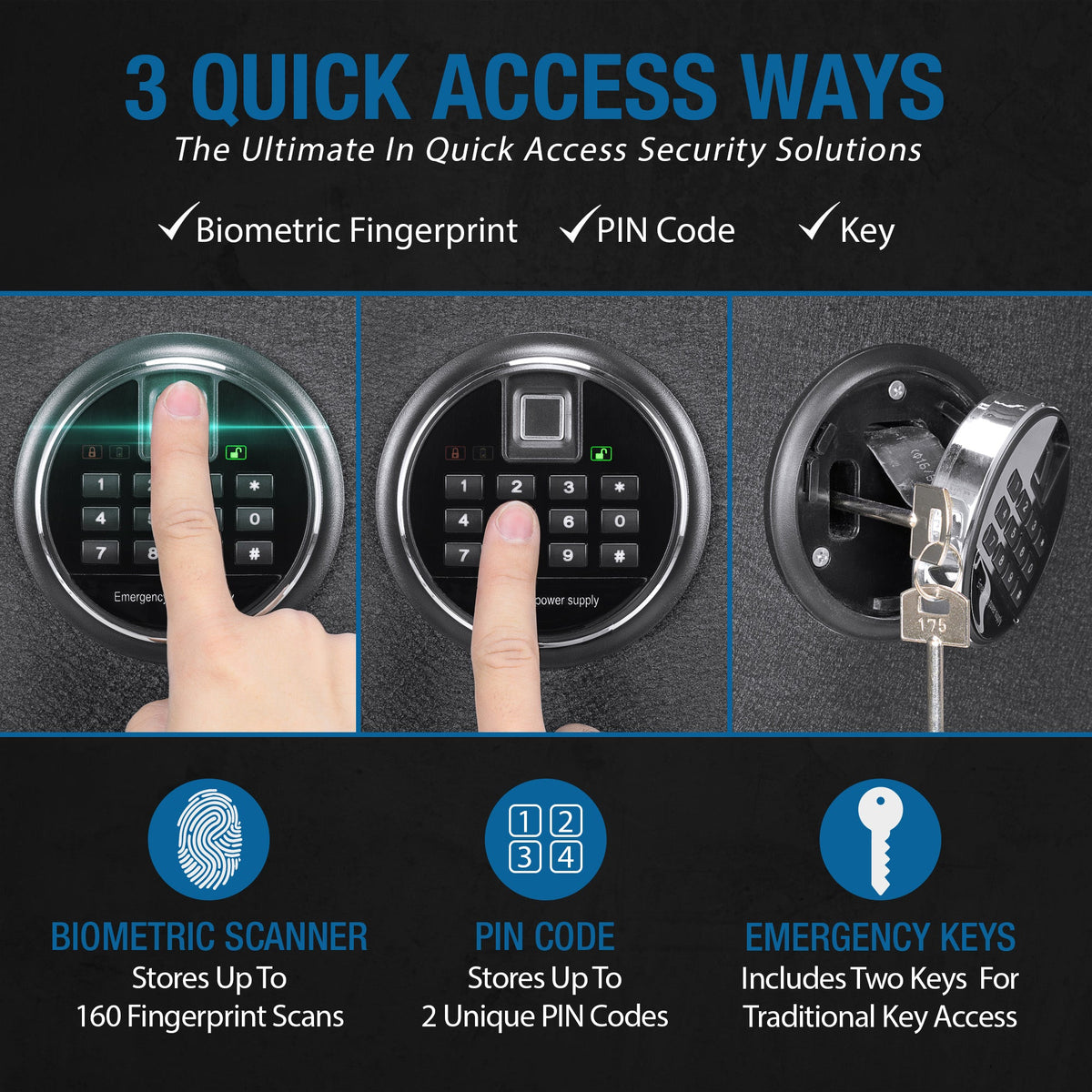
Lock: biometric fingerprint scanner with keypad. 160 fingerprints and two PIN codes stored.
Entry modes: single entry, where a print or a code opens it; or dual entry, where both are required. Switchable at the keypad.
Override: two backup keys, and an external 9V terminal for jump-starting a flat safe. The 9V battery is not included.
Locking bolts: eight in total — four live steel bolts and four steel deadbolts. Diameter and placement not stated by the manufacturer.
Door: recessed, for pry resistance.
Door assembly thickness: not stated by the manufacturer. Barska publishes a single material figure of 2 mm, which we have converted to 0.08", without separating the door from the body — the usual convention in this trade.
Wall thickness: 0.08" steel
Hinges: not stated by the manufacturer.
Alarm: motion sensor; wrong PIN code; unregistered fingerprint. Silent access mode available. Low-battery warning.
Fire, water & media
Fire rating: 25 to 30 minutes at 1,400°F, as stated by the manufacturer. Barska's materials give the figure both ways, as 30 minutes and as a 25-to-30 range; we print the range and would plan on the lower end of it, which is how we would want it given to us. Certifying body: not stated by the manufacturer.
Media / data rating: Not a media safe. This rating is built to protect paper. A drive, a tape or a strip of film needs an interior held below 125°F, and this is not built to that promise.
Water rating: None claimed.
The rest
Power: four AA batteries, not included. External 9V backup access, battery not included.
Warranty: one year limited.
Manufacturer part number: AX13744
UPC: 790272008018
Finish: matte black
In the box: two backup keys, mounting hardware, two adjustable shelves with brackets
· · ·
Single entry, and dual
The two modes are the real decision on this safe, and it is worth making deliberately rather than discovering later.
In single entry, either credential opens it — a registered finger or a PIN. That is the household setting. It is fast, it survives a cut thumb or a wet hand, and anyone you have enrolled can get in without you.
In dual entry, the safe wants both: the code and then the finger. Nothing opens on one alone. That is the setting for a shared office, a rented room, a house with a cleaner and a dog-walker and a plumber in it on a Tuesday — anywhere a code could be watched over a shoulder. The cost is honest and small: you cannot open it one-handed in a hurry, and you cannot talk someone through opening it over the telephone. Which is, of course, the point.
Then there is the number, which looks like a misprint and is not: 160 fingerprints. No household has 160 fingers to enrol. What that memory is actually for is redundancy on the fingers you do have. A reader is only as good as the impression it was given, so enrol the same thumb six or eight times — flat, rolled slightly left, slightly right, dry, after washing up — and the scanner stops being temperamental. That single habit is the difference between a biometric lock people trust and one they end up opening with the key.
And the silent mode turns the confirmation beeps off. A small thing in daylight. Not a small thing at two in the morning, when the reason you are at the safe is that you think somebody else is in the house.
Eight bolts, and what each of them is for
The specification says four live bolts and four deadbolts, and the difference between those two is worth a paragraph, because it is the difference between two quite separate attacks.
The four live bolts are the ones that move. Lock the safe and they drive out of the door edge into the body, which is what holds the door shut against a pull. The four deadbolts do not move at all. They are fixed pins that sit inside the frame while the door is closed, so that even if the hinge side is cut away entirely the door has nothing to swing on and nowhere to go. In the usual arrangement the fixed set lives on the hinge side for exactly that reason; Barska does not state the placement, and if it matters to your installation, ask us and we will put the question to them.
The recessed door is the third piece of the same idea. Prying is not a contest of strength but of purchase — a bar needs a lip and a gap before it can do anything at all. Setting the door back into the body takes the lip away.
What none of that changes is the steel, and we would rather say so here than let the bolt count imply something it should not. The body is 0.08" — cabinet steel, not plate. Eight bolts will comfortably outlast the wall they are anchored in, and a fire-resistant cabinet of this weight is mostly insulation rather than metal, because the insulation is what the fire rating is bought with. At 103.4 lbs it is far past a casual lift and nowhere near past two determined people with a hand truck and an afternoon when nobody is home. So anchor it. The holes are pre-drilled and the hardware is in the box, and a bolted-down safe changes the problem from carrying it away to attacking it in your hallway, in the dark, making noise.
· · ·
What this is not
It is not a media safe. That standard asks for an interior held below 125°F, because a drive or a tape is ruined long before paper chars. This cabinet is rated to protect paper. If what matters most to you is photographs living on a hard drive.
It is not water rated. No claim is made, and there is no seal here to make one with. Worth knowing, because a house fire is generally followed by a great deal of water.
It is not a burglary-rated safe. No UL listing is claimed for the body or the door, and none is implied here. Eight bolts and a recessed door are a sound arrangement, and 0.08" of steel is what it is. Anchor it and it does its job; leave it standing free in a spare room and you have bought a heavy box with a handle on it.
It is not a listed firearm safety device. Barska's own specification says so plainly. If a DOJ-listed device is what you need, Barska builds models that carry the listing and this is not one of them — better said here than discovered later.
It does not arrive with batteries. Four AA for the lock, and a 9V if you want one standing by for the external backup terminal. Worth having in the house before it lands.
On the maker
Barska started in 1994 in sports optics — binoculars, riflescopes, spotting scopes — and came to safes later, arriving with a manufacturer's habits rather than a marketer's. You can see it in the specification sheet, which is unusually willing to write the word no. This one states outright that the safe is not a listed firearm safety device, in a place on the page where a less careful company would simply have left a silence.
Their biometric range is the part of the catalogue we find most interesting, because it is where a mass-market maker is doing something that used to be reserved for far more expensive cabinets, and doing it at a price an ordinary household will actually pay. They sell broadly — hardware and sporting retail, catalogues, the general market — and a specification written for that channel answers that channel's questions well. A collector's questions are simply different ones. Where a figure we would have liked is not printed, we have said so above rather than guessed at it, and where you need one of those answers before you commit, ask us and we will write to Barska for it. We are in touch with them regardless.
We carry this one because it does an unglamorous job properly: half an hour of fire protection for paper, a lit interior on two adjustable shelves, eight bolts behind a recessed door, and a lock that opens fast enough to be used every day rather than admired once a year.
· · ·
Questions
Will my documents fit?
Letter-size papers lie flat with room around them — the interior is 15.2 inches wide and 9.45 deep. Legal-size folders are the awkward case: at 9.5 inches they are a fraction too wide to lie flat, but they stand upright without difficulty, and at 24.25 inches of interior height there is room above them for a shelf as well. Deeds, titles, certificates and passports are letter-size or smaller and present no problem at all.
What does 25 to 30 minutes at 1,400°F actually mean?
It means a cabinet of this pattern was closed, taken to that temperature in a furnace, and opened again with its interior still below the point at which paper begins to char. It is a controlled, repeatable measurement, which is what makes it worth quoting — and also why it describes an oven rather than a house. Two practical things follow. Heat gathers at the ceiling, so a safe standing on a lower floor spends a fire in the coolest air the building has. And a safe that has been through a fire has spent what it had; if that ever happens, ask us before you trust it a second time and we will put the question to Barska.
How many people can have access?
Up to 160 fingerprints and two PIN codes. The print memory is generous enough that the sensible use of it is not more people but more impressions of the same fingers — enrol each thumb several times, at slightly different angles, and the reader becomes reliable rather than moody.
What if a finger will not read, or the batteries die?
Two backup keys come with the safe, and there is an external 9V terminal on the outside that lets you power the keypad long enough to open a safe whose AA batteries have gone flat. The lock warns you while they still have life in them. One piece of advice, given freely: keep the keys somewhere that is not this safe — a relative's house, a drawer at the office, anywhere but inside the thing they were made to open.
Will it protect a hard drive, or old photographs?
Not in a fire. The rating here is for paper; drives, tapes, negatives and slides need an interior held below 125°F, which is a different and more expensive cabinet. Tell us what you are keeping and we will point you at the right one.
Can I move it myself?
At 103.4 lbs it sits below the weight where freight and liftgates enter the conversation, and at just under 17 inches wide it goes through an ordinary doorway without drama. It is still well past a one-person carry, and further past one up a staircase. Plan on two people and something with wheels for the last part of the journey.