Barska
Barska Tall Fire Resistant Safe - 11.87 cu ft Interior, Keypad Entry, AX12218
Barska Tall Fire Resistant Safe - 11.87 cu ft Interior, Keypad Entry, AX12218
Couldn't load pickup availability
Share


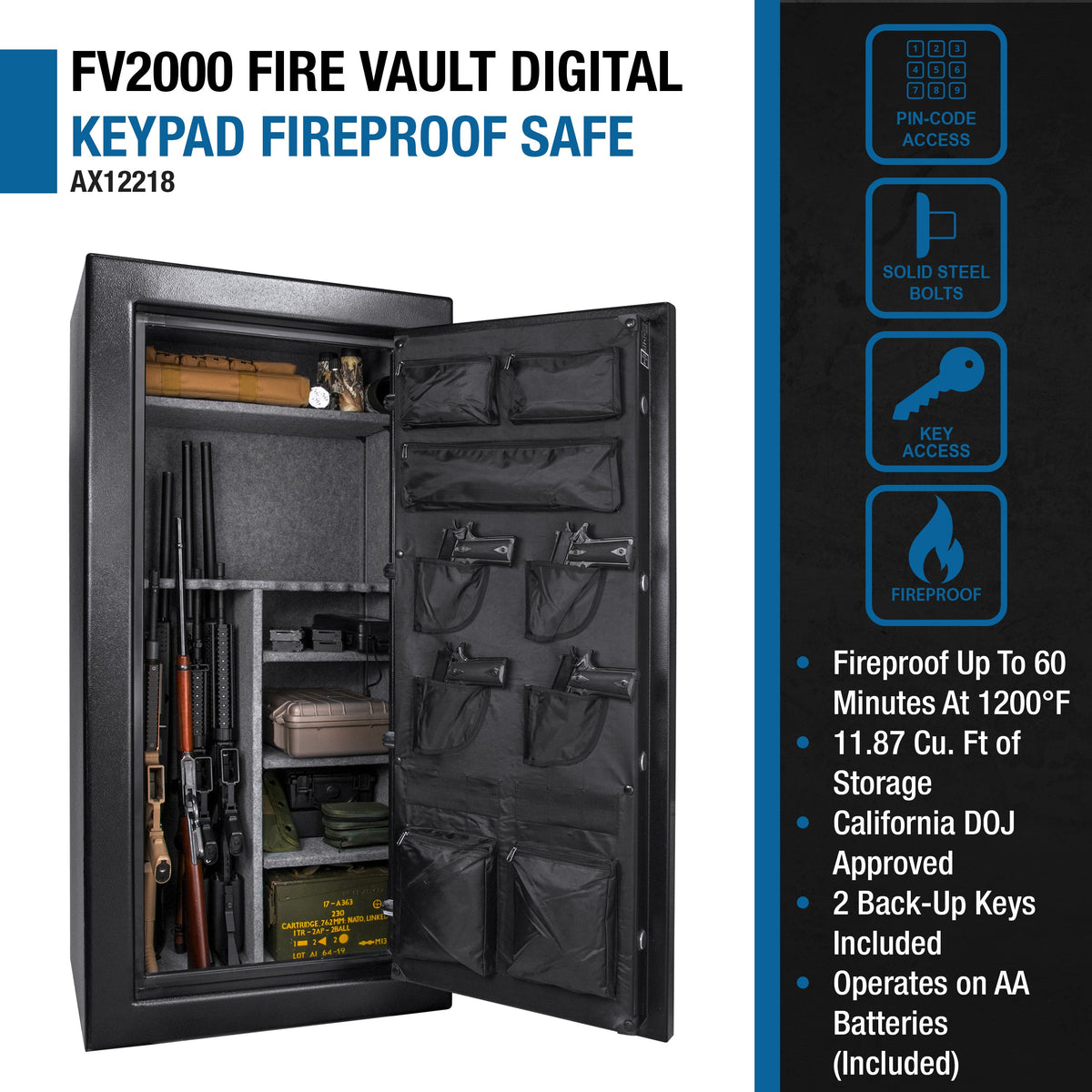
Close to twelve cubic feet of interior, standing fifty-six inches clear from floor to crown, behind an hour of fire lining. Most household safes are built around the drawer — papers, a watch box, the passports. This one is built around the things a house has nowhere to put: the tall, the long, the awkwardly shaped, stored upright rather than laid down.
It comes fitted as a gun cabinet, with a thirty-position rack, removable shelves and dividers, and pouches on the inside of the door. Barska state it is approved by the California Department of Justice for storage. The rack, the shelves and the dividers are all described as removable, so the column can be emptied out and used as one tall space.
What it holds
Room for long guns standing upright, the tripods and hard cases that have lived in a hallway because nothing else will take them, and the folder of serial numbers and receipts that proves any of it is yours.
A note on the number
Barska states thirty positions, without scopes or accessories. Thirty across 25.04 inches of interior width is a little over eight-tenths of an inch apiece, which is an arithmetic that only closes with bare rifles nested tight against one another. Whether the rack runs as one row or two across the 14.6 inches of depth is not stated by the manufacturer. Add optics and the practical number falls — as a working rule a scoped rifle takes the width of two bare ones, and a thumbhole stock or a thick recoil pad costs about the same.
Specifications
Interior
56.1"H × 25.04"W × 14.6"D
Interior volume, calculated: 11.87 cu ft
30-position rifle rack, quoted without scopes or accessories
Removable shelves and dividers. The number of shelves is not stated by the manufacturer. Barska's retail listings describe the rack as removable as well.
Inner locking box: none
Door organizer: door-mounted pouches
Exterior & siting
59.06"H × 28"W × 20"D
358.6 lbs, which is Barska's figure for the cabinet. Freight listings commonly quote around 500 lbs; that is the weight on the pallet, and it is the number the carrier works to.
Anchoring: mounting hardware included. Whether the pre-drilled holes sit in the base, the back or both is not stated by the manufacturer.
Clearance: front access. Allow for the door to swing clear of the frame. Hinge side not stated by the manufacturer.
Wheels: none.
Security
Lock: electronic keypad. One PIN code stored.
Override: two backup keys.
Locking bolts: six steel deadbolts. Diameter and placement not stated by the manufacturer.
Door assembly thickness: not stated by the manufacturer. Barska publish a single figure for the steel — 2 mm, which is 0.08" — without saying whether the door differs from the body.
Wall thickness: 0.08" steel over a gypsum board fire lining.
Hinges: not stated by the manufacturer.
Alarm and lockout: lockout after repeated incorrect entries, and a low-battery warning. A silent mode mutes the keypad tones.
Firearm storage: Barska state the FV-2000 is approved by the California Department of Justice for storage. The Department's certified list is searchable on its own site and is revised from time to time, so check it against the day you buy. We are glad to point you at it.
Fire, water & media
Fire rating: up to 1 hour at 1,200°F, as stated by the manufacturer. Certifying body: not stated by the manufacturer.
Media / data rating: Not a media safe. This rating is built to protect paper. A drive, a battery or a lens needs an interior held below 125°F, and this is not built to that promise.
Water rating: None claimed.
The rest
Power: four AA batteries, not included. Some listings show a 9V battery instead; Barska's own specification says four AA, and says they are not in the box.
Warranty: one year limited.
Manufacturer part number: AX12218
UPC: 790272000036
Finish: gloss black
In the box: two backup keys, removable shelves and dividers, the 30-position rack, mounting hardware
What an hour covers
An hour at 1,200°F means a cabinet of this pattern was closed, heated to that temperature in a furnace, and opened again with its interior still below the threshold the standard sets. It is a repeatable test, which is why it is worth printing.
The standard is written for paper: an interior held below the point at which paper chars, conventionally 350°F. Wood, adhesives, polymer stocks and lens seals have thresholds of their own that the paper test does not measure.
The protection comes from water. The gypsum board in these walls holds moisture within its structure; heat drives it out as steam, and the steam carries the energy away. The interior stays cool while there is moisture left to spend, and an hour is what this wall has to spend. Heat also gathers at the ceiling, so a fifty-nine-inch cabinet does better on a ground floor than in an upstairs room under the roof.
Siting and delivery
Twenty-eight inches of width is the measurement to take first. A standard American front door is about 36 inches and will take it; interior doors run 30 to 32, which leaves an inch or so of air on each side and no room for hands. Measure the narrowest door on the route, then measure the turn at the top or bottom of any staircase — a rigid fifty-nine-inch object needs diagonal room on a turn, and that is usually the tighter question.
The floor is not a difficulty. Residential floors are framed for spread load, and 358 pounds over a 28 by 20 inch footprint sits well inside what one carries. Set it across the joists rather than along a single one, near a bearing wall if the choice is free. The height matters more than the weight: fifty-nine inches on a footprint that size will go over if it is pulled at, so anchor it. The hardware is in the box.
It arrives by LTL freight, on a pallet, lowered on a liftgate, at the curb. From there it is two people and a stair-climbing dolly — or, if you would rather not be one of the two, write to us before you order and we will quote you for a crew to bring it inside and set it where you want it. The delivery section below explains what the freight rate covers and why the rest is priced apart from it.
What this is not
It is not fireproof, whatever the trade calls it. The word is a category convention and you will find it on listings everywhere, ours among them. What exists is a rating: up to one hour, 1,200°F, measured in a furnace.
It is not a media safe. That standard asks for an interior below 125°F, because a drive, a battery or a lens coating is spent long before paper is. If what you are storing includes optics or electronics you would hate to lose, the rating here was not written with them in mind.
It is not water rated. No claim is made and no seal is described. Worth knowing, since a house fire is generally followed by a great deal of water.
It is not a burglary-rated safe. No UL burglary listing is claimed for the body or the door, and none is implied here. The steel measures 0.08 inches — 2 mm — and the mass in these walls is insulation rather than armor. Six deadbolts, a keypad and 358 pounds bolted through a floor will turn away an opportunist. A strongroom is a different class of object, and costs accordingly.
It stores one code. One PIN, and two backup keys. In a household where more than one person needs to open it, that means a shared code or a key each — better settled in advance.
It does not arrive with batteries. Four AA, and they are not in the box.
On the maker
Barska began in 1994 in sports optics — binoculars, riflescopes, spotting scopes — and came to safes afterwards, bringing a manufacturer's habits rather than a marketer's. It shows in the specification for this one, which prints without scopes or accessories in the same breath as the thirty-gun capacity. That qualification costs a sale now and then, and they print it anyway.
They sell broadly — sporting retail, hardware, the general market — and a specification written for that channel answers the questions that channel asks. A collector's questions are different ones: which way the hinges face, how many shelves come in the carton, what the door plate measures apart from the body. Where a figure we would have liked is not printed, we have said so above rather than guessed at it. If you need one of those answers before you commit, ask us and we will write to Barska for it.
Questions
How many rifles will actually fit?
Thirty bare ones, which is what the rack is built for and what Barska quote. With optics on, fewer — a scoped rifle takes roughly the width of two unscoped positions. Length is not the constraint: the interior stands 56.1 inches and most long guns run forty to fifty inches overall, so they stand upright with room above. Tell us what you own and we will work the width through with you.
Can I take the rack out and use the full height?
Barska's retail listings describe the rack as removable, and the shelves and dividers are removable as well. What the fixings are, and whether anything remains in the column once the rack is out, is not stated in their specification. If that decides it for you, ask us before you order and we will put the question to them.
Can two people have their own code?
No. The lock stores one PIN. There are two backup keys, so a second person can be given a key rather than a code.
Will it protect a hard drive or a scope in a fire?
Not to a standard anyone should rely on. The rating here is the paper rating. Batteries, coatings and lens seals need an interior held below 125°F, which is a different and more expensive class of cabinet.
How does it arrive, and can I get it inside?
On a pallet, by freight, lowered on a liftgate, at the curb — which is where a freight rate ends. From there it is two people and a stair-climbing dolly, or a crew we can quote you for, who will bring it in and place it. Twenty-eight inches of width will clear a standard front door but is tight through an interior one, and the staircase turn is what to measure next.
Why is inside delivery an extra charge?
Because of the weight, and only because of the weight. At 358 pounds this travels on a pallet by freight truck, and a freight rate buys the truck and the liftgate — not the hour of labor it takes to walk a quarter-ton cabinet from the road into a room. That hour is bought from a crew, so it is quoted separately. The same cabinet at eighty pounds would come by van and be carried in by one person, at no extra cost to anyone.
Is the California listing current?
Barska state the FV-2000 is approved by the California Department of Justice for storage. The Department publishes its own certified list and revises it from time to time, so check it against the day you buy rather than taking a listing's word for it — ours included. We are glad to point you at it.
Delivery
Why it comes by freight, and why the last fifty feet is priced apart from it
At 358 pounds this is past what a parcel carrier will take — UPS and FedEx stop at 150 pounds a package. So it travels the way heavy goods travel: strapped to a pallet, on an LTL freight truck, priced by weight and by the share of the trailer it occupies.
What the freight rate buys is a truck to your address and a liftgate to lower the pallet to the road. The driver stays with the vehicle. That is the service the rate is written around, and it is the same for every pallet on the truck.
Everything past the curb is a second job, done by hand. A cabinet this heavy cannot be carried; it is walked on a stair-climbing dolly by two or three people with floor protection down, and every threshold, step and turn adds time. That labor is bought from a crew by the hour rather than from the carrier by the mile, which is why it is quoted rather than folded into the price. The weight is the whole of the reason — the same cabinet at eighty pounds would arrive in a van and be carried in by one person.
What is included
Curbside, residential. The pallet is lowered at the end of your driveway on a liftgate. Moving it from there is yours to arrange, so have the people and the equipment in place before the truck comes.
Curbside, business. Delivered to the nearest accessible point — a loading dock, or the curb. Moving it into the building is yours to arrange.
The carrier delivers on a pallet. Unboxing, breakdown of the freight and removal of packaging are not part of a curbside delivery.
What we can quote you for
Inside delivery, ground floor. The crew brings it just inside the first door — a foyer, a garage, a lobby. It does not cover floors above or below the level the truck can reach.
White glove, ground floor. The crew brings it inside, places it in the room of your choice, unpacks it, protects your floors on the way through and takes the packaging away with them.
Write to us before you order with your address and where the cabinet is to stand, and we will come back with a figure. Bolting it to the floor is a separate matter — drilling into a structure is a contractor's work, and a crew that will do it does so under its own license. Tell us if you want it anchored and we will ask when we quote.
Freight terms
Where we ship. The lower 48 states. This one does not travel to Alaska, Hawaii or the territories.
Contact details. A working phone number is needed at checkout. The carrier uses it to arrange the appointment, and we use it if anything about the delivery needs settling first.
Delivery time. Allow 7 to 14 business days. The carrier will contact you before delivery to schedule a time.
Inspection. Look at the shipment before you sign the proof of delivery. If anything is damaged or missing, note it on the POD, photograph it, and write to us the same day.
Please read our full return policy on our site